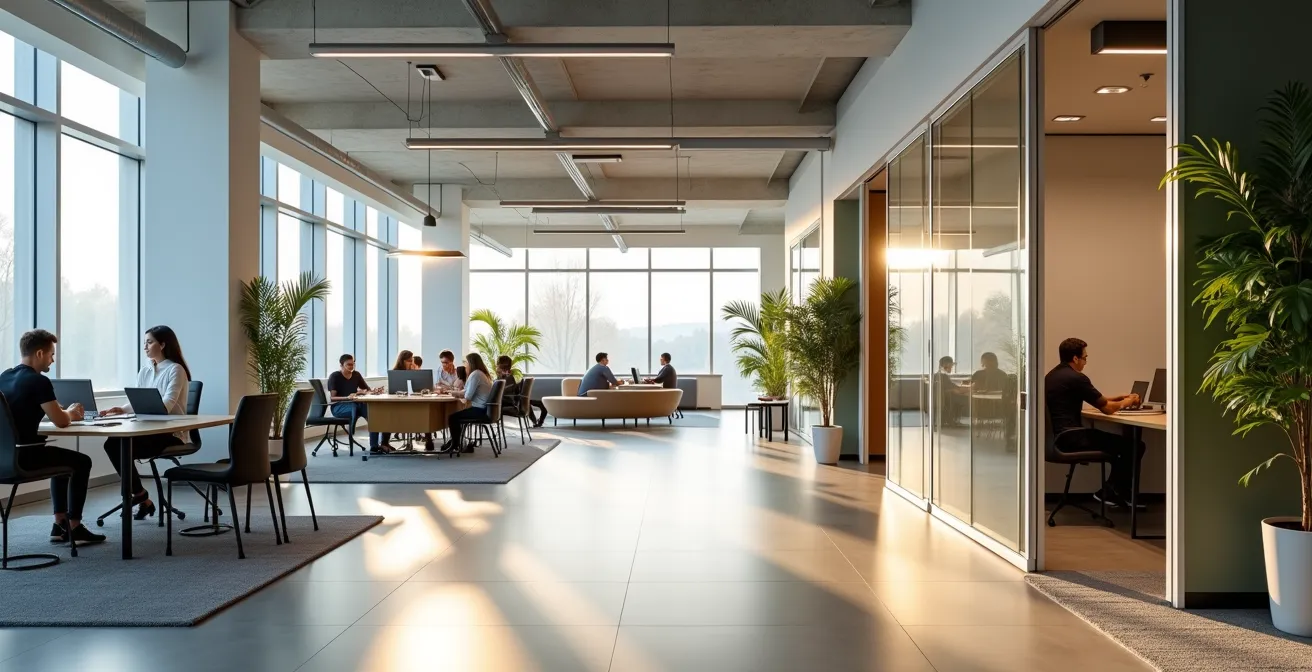
Activity-Based Working is a financial strategy to cut real estate OpEx by up to 30% by converting your office from a fixed liability into a productive, capital-efficient asset.
- It justifies upfront CapEx in renovation through significant, long-term rent and utility savings.
- It optimizes every square foot for “productivity density,” measuring output and not just headcount.
Recommendation: Model the transition as a balance sheet maneuver, focusing on break-even timelines and the return on investment per square foot.
For any Chief Financial Officer, the corporate headquarters represents one of the most significant and rigid items on the balance sheet: a fixed-lease liability. In an era of hybrid work, paying for underutilized space is a direct drain on capital that could be deployed elsewhere. The common discourse around “flexible offices” and “collaboration hubs” often frames the solution as a simple design trend, a matter of aesthetics and employee perks. This view misses the fundamental financial opportunity.
The real conversation isn’t about beanbags and open-plan layouts; it’s about strategic asset optimization. The underlying assumption that you need one desk per employee is an obsolete relic of a bygone work model. But if the key to unlocking millions in savings isn’t just about shrinking the office, what is the correct financial lever to pull? The answer lies in treating the workplace not as a static cost center, but as a dynamic, high-performance asset. This requires a calculated shift in thinking: from minimizing upfront spend to maximizing long-term value.
This is where Activity-Based Working (ABW) transcends interior design and becomes a powerful financial instrument. It proposes a direct trade: invest a calculated amount of Capital Expenditure (CapEx) into a strategic renovation to unlock a far greater, recurring reduction in Operational Expenditure (OpEx). This guide provides the financial framework to execute this maneuver. We will dissect the CapEx/OpEx trade-off, address the critical human factors that determine success, and provide a blueprint for phasing the transition to de-risk the investment and maximize productivity ROI.
This article provides a comprehensive financial and strategic breakdown for implementing Activity-Based Working to achieve significant real estate cost reductions. Explore the sections below to master each component of this transformative strategy.
Summary: A Financial Blueprint for Office Space Optimization
- Why Spending More on Renovation (CapEx) Saves Millions in Rent (OpEx)
- How to Train Employees to Switch Zones Based on Tasks, Not Habit
- Collaboration Hubs vs. Focus Libraries: What Is the Ideal Ratio for Tech Companies?
- The “Homeless” Risk: Why Introverts Struggle With ABW and Quit
- How to Phase a Renovation While the Office Is Still Occupied
- Leasing vs. Buying Machinery: Which Strategy Maximizes Cash Flow During Uncertainty?
- How to Create “Deep Work” Zones in a Small 200m² Office
- Why Poor Air Quality Is Reducing Your Team’s Cognitive Scores by 15%?
Why Spending More on Renovation (CapEx) Saves Millions in Rent (OpEx)
The core thesis of an ABW-driven downsizing is a strategic trade-off that every CFO can appreciate: deploying a one-time CapEx investment to generate a significant, long-term reduction in recurring OpEx. The traditional office lease is a fixed liability, often based on a simplistic cost-per-square-foot metric that ignores how the space is actually used. ABW shatters this model by re-engineering the office to support specific activities, thereby increasing the productivity density of a smaller, more efficient footprint.
Instead of funding empty desks, capital is redirected towards creating a mix of zones—collaboration hubs, quiet focus areas, meeting rooms—that are used with high intensity. This allows for a significant reduction in total leased square footage, directly impacting the largest OpEx line item: rent. The initial renovation cost, while substantial, is a depreciable asset that, when modeled correctly, delivers a clear break-even point and a compelling ROI through rent, utility, and maintenance savings over the lease term. It’s about spending smart money once to stop wasting money every month.
Case Study: Unispace Seattle’s ABW Transformation
A prime example of this strategy in action is the transformation of Unispace’s own Seattle headquarters. By moving from a traditional layout to a fully optimized ABW model, they achieved remarkable space efficiency. As documented in an analysis of their ABW implementation, the redesign increased the available dedicated workspace by 33% and the shared space by 20%, all within a more compact and cost-effective real estate footprint. This demonstrates how upfront CapEx directly translates into a more productive and valuable asset.
To properly evaluate this financial maneuver, a rigorous analysis is required. It’s not enough to estimate savings; a detailed model must be built to justify the investment to the board and stakeholders.
Your Action Plan: Financial Analysis Framework for a CapEx vs. OpEx Shift
- Calculate baseline OpEx: Itemize all current monthly rent, utilities, cleaning services, and routine maintenance costs to establish a clear financial starting point.
- Project CapEx investment: Factor in all hard and soft costs, including renovation, furniture systems, technology infrastructure upgrades, and project management fees.
- Model space efficiency gains: Quantify the potential square footage reduction based on utilization studies and the planned ABW zone ratios. This is your primary OpEx saving driver.
- Calculate break-even timeline: Determine the exact point in months or years when the cumulative OpEx savings officially exceed the initial CapEx investment.
- Include tax benefits: Factor in the depreciation advantages of CapEx investments to calculate a more accurate and favorable after-tax ROI.
How to Train Employees to Switch Zones Based on Tasks, Not Habit
The financial model for ABW hinges on one critical, non-financial factor: employee behavior. A perfectly designed space is fiscally worthless if employees continue to chain themselves to a single spot out of habit. The transition to ABW is a change management initiative that requires deliberate training to rewire ingrained behaviors. The goal is to teach employees to see the office not as a collection of desks, but as a toolkit of specialized environments, and to consciously select the right “tool” for the task at hand.
This training should be practical and task-oriented. Instead of abstract principles, use real-world scenarios: “When you need to draft a quarterly report, use a Focus Library booth. When you’re brainstorming a campaign with your team, book a Collaboration Hub.” Leadership must champion this behavior, moving between zones themselves. Success is not about enforcing rules, but about demonstrating the tangible productivity benefits of using the right space for the right job, transforming the office from a place of habit to a platform for performance.

As seen in the workflow above, management’s role shifts from monitoring presence to empowering performance. The ultimate goal is to build a culture of trust and autonomy, where the focus is on results, not location. This requires a fundamental shift in leadership mindset, as noted by experts in the field.
Trust is central to the concept. Let go of control and details and manage on performance and clear expectations.
– Ylva Pålsson, My Workspaces consultant
Collaboration Hubs vs. Focus Libraries: What Is the Ideal Ratio for Tech Companies?
Once the principle of ABW is accepted, the critical design question becomes one of allocation. How do you divide a smaller, more expensive-per-square-foot space to maximize productivity? The answer is not a one-size-fits-all formula; it is a data-driven decision based on the specific workflows of your organization. For tech companies, where work modes can swing dramatically between intense, solitary coding and dynamic team-based problem-solving, this ratio is particularly crucial.
The two primary work zones are Collaboration Hubs (designed for interaction, brainstorming, and co-creation) and Focus Libraries (designed for deep work, concentration, and individual tasks). An engineering-heavy department might require a 70/20 split in favor of focus space, whereas a sales or marketing team might need the opposite. Conducting pre-transition utilization studies and employee surveys is not an optional expense; it is essential due diligence to inform the CapEx plan. An incorrect ratio leads to “financial friction”—wasted space and frustrated employees—undermining the entire business case. Getting it right, however, pays dividends, as a 2020 study by Veldhoen + Company found a 17% increase in employee satisfaction post-ABW transition, a metric that directly impacts retention and recruitment costs.
The following table provides a strategic starting point for modeling space allocation for different functions within a typical technology firm. These ratios should be the beginning of your analysis, refined by your own internal data.
| Department | Focus Space % | Collaboration Space % | Recharge Space % |
|---|---|---|---|
| Engineering/Development | 70% | 20% | 10% |
| Sales/Business Development | 40% | 50% | 10% |
| Marketing/Creative | 50% | 40% | 10% |
| HR/Administration | 60% | 30% | 10% |
The “Homeless” Risk: Why Introverts Struggle With ABW and Quit
From a CFO’s perspective, the greatest risk in an ABW transition is not budget overrun, but talent attrition. The most common point of failure is neglecting the needs of the introverted portion of your workforce. While extroverts may thrive in dynamic, social environments, introverts can experience an ABW office as a source of constant stress and unpredictability. This feeling of being “homeless”—lacking a stable, personal, and quiet space to retreat to—can lead to a significant drop in productivity and, ultimately, resignation.
This isn’t a matter of preference; it’s a matter of cognitive performance. The constant low-level distraction of open spaces and the daily search for a suitable workspace can deplete the mental energy introverts rely on for deep work. The financial impact is twofold: the direct cost of replacing a skilled employee and the indirect cost of lost productivity. Therefore, investing in features that provide psychological safety for introverts is a non-negotiable part of the ABW business case. Research shows that providing quiet spaces yields a quantifiable return, with one study documenting a 16.9% increase in cognitive performance when individuals can work without interruption.
To mitigate this risk, several tactical investments are crucial:
- Implement “anchor points” like dedicated personal lockers and allow pre-booking of spots in quiet zones to provide a sense of stability.
- Deploy workplace apps showing real-time office density, empowering employees to choose low-traffic areas.
- Install single-person acoustic phone booths to guarantee privacy for calls and focused tasks.
- Create “library rules” zones with strictly enforced no-interruption protocols during peak hours.
- Provide high-quality noise-canceling headphones and visual signals (like desk lights) to indicate focus time.
How to Phase a Renovation While the Office Is Still Occupied
A primary logistical challenge for any office renovation is the potential for business disruption. For a CFO, this translates to a direct hit on revenue and productivity. The solution is a phased renovation strategy, which allows the company to remain operational while the transformation is underway. This approach de-risks the project by breaking it down into manageable stages, but it requires careful planning and the use of “swing space”—temporary workspaces for displaced employees.
The financial viability of each swing space strategy must be evaluated. Leasing external coworking space offers low disruption but comes at a premium. Converting a large internal conference room is a low-cost option but can create a different set of operational bottlenecks. A subsidized work-from-home policy during a department’s renovation phase can be highly cost-effective and popular with employees. The most expensive but least disruptive option is to schedule all construction work for nights and weekends. The choice depends on a cost-benefit analysis weighing the price of the swing space against the potential cost of lost productivity.

The key is to maintain business continuity at all costs. The split composition shown above, with a clear barrier between the construction zone and the functional temporary workspace, illustrates the goal: transformation without interruption. This requires a robust logistical plan and clear communication with all teams about timelines and temporary arrangements.
The following table compares the primary swing space strategies from a financial and operational perspective, providing a framework for your decision-making process.
| Strategy | Cost Impact | Disruption Level | Employee Satisfaction |
|---|---|---|---|
| Coworking space lease | Medium-High | Low | High |
| Large conference room conversion | Low | Medium | Medium |
| Subsidized work-from-home | Low-Medium | Very Low | High |
| Weekend/night construction only | High | Very Low | Very High |
Leasing vs. Buying Machinery: Which Strategy Maximizes Cash Flow During Uncertainty?
In the context of an ABW renovation, “machinery” translates to the critical furniture and technology that make the space functional. The decision to lease this equipment (OpEx) versus buying it outright (CapEx) has significant cash flow and balance sheet implications, especially in an uncertain economic climate. The rise of Furniture-as-a-Service (FaaS) offers a compelling OpEx-based alternative to traditional procurement.
Purchasing furniture is a large, upfront CapEx hit that ties up capital. While the asset depreciates over time, providing a tax shield, it also locks the company into a specific configuration. In a dynamic business environment, this lack of flexibility can become a liability. If the company needs to downsize further or reconfigure spaces to adapt to changing team structures, owned furniture becomes a logistical and financial burden to store or dispose of.
Leasing, or FaaS, converts this capital investment into a predictable monthly operating expense. This approach preserves cash flow for core business activities and provides immense flexibility. FaaS contracts often include maintenance, and more importantly, they allow a company to scale its furniture up or down with minimal friction. From a CFO’s perspective, this transforms furniture from a static, depreciating asset into a flexible, on-demand service, perfectly aligning the real estate cost model with the fluid nature of a modern workforce.
A framework for evaluating this choice should include:
- Cash Flow Impact: Compare the large upfront payment for purchase against the steady, predictable monthly payments of a lease.
- Flexibility Needs: Assess how likely your headcount or team structures are to change over the next 3-5 years. The more uncertainty, the more valuable leasing becomes.
- Tax Implications: Model the difference between fully deducting lease payments annually (OpEx) versus depreciating the purchased asset over several years (CapEx).
- Total Cost of Ownership (TCO): A purchase analysis must include the often-hidden costs of delivery, installation, maintenance, and eventual disposal or decommissioning.
How to Create “Deep Work” Zones in a Small 200m² Office
The promise of reducing an office footprint to a small, hyper-efficient space of 200m² (approx. 2,150 sq ft) is fiscally attractive. However, this density creates a significant challenge: protecting the acoustic environment required for “deep work.” Without dedicated, acoustically-isolated zones, a small office becomes a hotbed of distractions, crippling the productivity of employees engaged in focused tasks like coding, writing, or financial analysis. As research indicates that almost 80% of office workers need quiet space to focus, failing to provide it is a direct path to productivity loss.
In a limited space, creating these zones is not about building walls, but about deploying smart, modular, and multi-functional acoustic solutions. The investment is in technology and materials that absorb, block, and mask sound. This includes high-backed acoustic sofas that create semi-private nooks, freestanding sound-absorbing panels that can be moved to reconfigure spaces, and, most critically, dedicated single-person office pods or booths. These pods offer total acoustic and visual privacy, serving as the ultimate deep work sanctuary within a bustling environment.

The cost of these solutions must be weighed against the cost of lost productivity from interruptions. A single high-value engineer or analyst regaining an hour of uninterrupted deep work per day provides a rapid and substantial ROI on the investment in an acoustic pod. In a small office, these zones are not a luxury; they are the essential infrastructure that makes a high-density environment financially viable.
Key strategies for acoustic optimization in tight quarters include:
- Installing freestanding acoustic panels to create visual and sound barriers between workstations.
- Implementing high-back ‘pod’ chairs that offer built-in sound absorption for individual seating.
- Adding sound-absorbing curtains to windows and using them as lightweight space dividers.
- Deploying white noise machines at calculated intervals for effective sound masking that covers distracting chatter.
- Creating time-based “library rules” zones during peak focus hours (e.g., 9-11 AM) where all conversation is prohibited.
Key Takeaways
- CapEx in renovation is a strategic investment designed to drastically cut long-term, recurring OpEx like rent and utilities.
- Data-driven space ratios are non-negotiable; allocation must be tailored to departmental workflows, not based on generic templates.
- Protecting “deep work” for all employees, especially introverts, is a financial imperative to prevent productivity loss and costly talent attrition.
Why Poor Air Quality Is Reducing Your Team’s Cognitive Scores by 15%?
As you implement an ABW strategy to increase space efficiency and employee density, a hidden financial risk emerges: poor air quality. Packing more people into a smaller footprint places a greater strain on HVAC systems. When ventilation is inadequate, levels of CO2 and Volatile Organic Compounds (VOCs) rise, leading to a measurable decline in cognitive function. This isn’t a minor inconvenience; it’s a direct hit to the productivity you are trying to optimize. The question in the title is rhetorical, but the danger is real—employees may feel sluggish, unfocused, and experience more headaches, all of which erodes performance.
From a financial standpoint, investing in upgraded HVAC systems, high-quality air filtration (MERV 13 or higher), and real-time air quality monitoring is a form of productivity insurance. The cost of these upgrades is a fraction of the payroll cost lost to diminished cognitive performance across the entire workforce. A well-managed ABW environment is not just about flexible space; it’s about a healthy space. In fact, when done right, the transition can be a net positive for output, with some organizations transitioning to Activity Based Working seeing a 13% increase in individual productivity.
The connection between density and air quality cannot be ignored. As workplace design experts caution in their implementation guidelines, this factor is paramount.
As you increase density in certain zones, proper ventilation becomes paramount to prevent drops in cognitive function.
– Workplace design experts, ABW implementation guidelines
Therefore, any CapEx budget for an ABW renovation must include a line item for ensuring the building’s systems can handle the increased load. Ignoring this factor means you are simply trading real estate cost for a far more expensive productivity cost.
To translate these strategies into a concrete financial projection, the next step is to build a detailed CapEx vs. OpEx model tailored to your current lease structure and workforce.