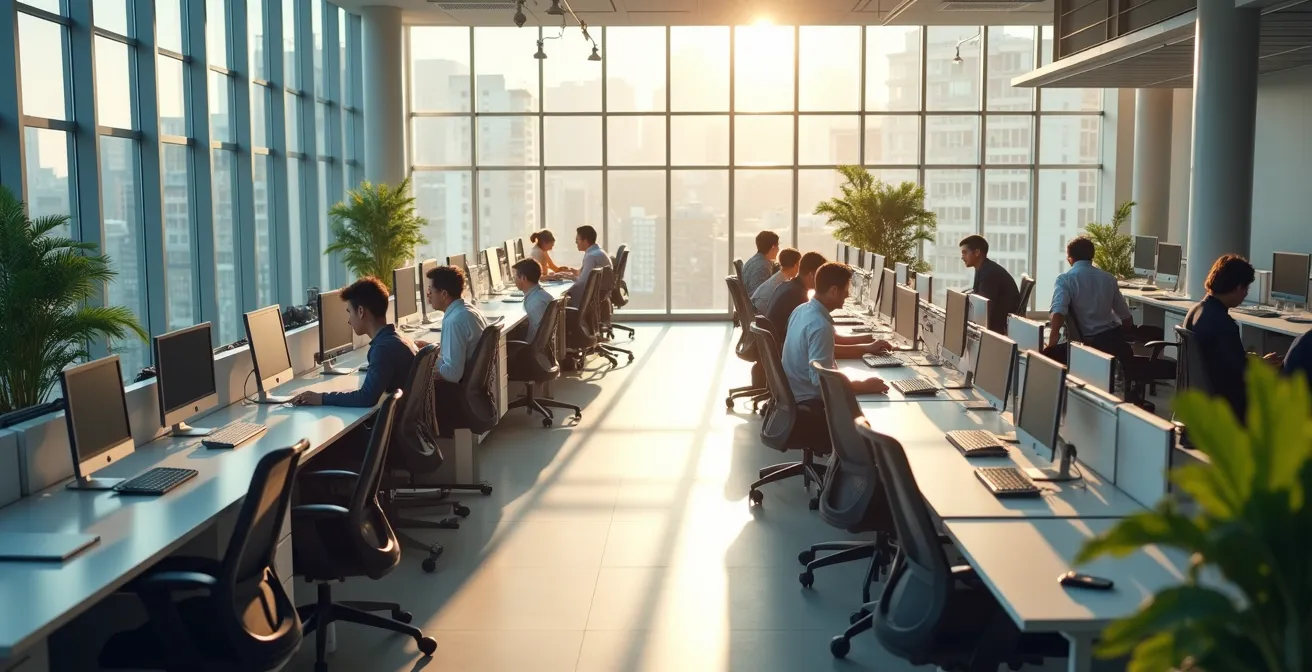
Contrary to popular belief, team lethargy isn’t a motivation problem; it’s an environmental problem. The invisible factors in your office air are measurably degrading your staff’s cognitive abilities.
- Stagnant meeting rooms can halve creative problem-solving capacity due to high CO2 levels.
- Improperly filtered air introduces fine particles (PM2.5) that directly slow down response times and decision-making.
Recommendation: Stop guessing about performance issues and start measuring your office’s environmental vitals—CO2, PM2.5, and ventilation rates. This isn’t a facilities issue; it’s a core business performance strategy.
You’ve invested in top talent, competitive salaries, and the best software. Yet, you walk through the office and feel a palpable sense of lethargy. Afternoon productivity slumps, big ideas seem to fizzle out in the boardroom, and there’s a recurring theme of headaches and minor illnesses. The conventional wisdom is to look at management, morale, or workload. You might consider team-building exercises or survey employee satisfaction. But what if the primary culprit is invisible, silent, and being inhaled by everyone, every second of the workday?
As an environmental health consultant, I can state with scientific certainty: your office building itself is likely the single greatest source of “environmental drag” on your team’s performance. We’ve been conditioned to see the office as a passive container for work, but the data is unequivocal. The physical environment is an active participant in your team’s cognitive function. Factors you can’t see—like CO2 concentrations, volatile organic compounds (VOCs), and microscopic particulate matter—are imposing a significant, measurable cognitive load on your employees. This isn’t about wellness fads or making the office “feel nicer.” This is about cognitive calibration.
This article will dissect the specific environmental failures that are sabotaging your team’s output. We will move beyond the platitudes of “adding more plants” and delve into the hard science of how poor air quality, inadequate lighting, and flawed hygiene protocols directly erode cognitive scores, decision-making speed, and creativity. The goal is to reframe your perspective: your office is not just real estate; it is a high-performance machine that is currently miscalibrated. By understanding the key levers, you can recalibrate it for peak cognitive output, turning your physical space from a liability into a formidable competitive advantage.
This guide will walk you through the critical failure points in most office environments and provide the data-backed interventions to correct them. We will explore everything from the air in your boardrooms to the light your night-shift teams work under, giving you a clear roadmap to unlock the latent potential your environment is currently suppressing.
Summary: Unlocking Cognitive Performance by Recalibrating Your Workspace
- Why Meeting Rooms Without Ventilation Are Idea Killers
- How to Integrate Plants in the Office Without Creating a Maintenance Nightmare
- Natural Light vs. Circadian LED: Is the Investment Worth It for Night Shifts?
- The HVAC Mistake That Causes Chronic Headaches and Absenteeism
- How to Schedule Cleaning Shifts to Minimize Disruption and Maximize Hygiene
- How to Structure Your Morning Routine to Peak for 10 AM Board Meetings
- The Cleanliness Protocol That Prevents Flu Outbreaks in Shared Desk Environments
- Designing an Office That Candidates Photograph and Share on Instagram?
Why Meeting Rooms Without Ventilation Are Idea Killers
The high-stakes board meeting is where strategies are forged and million-dollar decisions are made. Yet, most of these critical spaces are fundamentally designed to stifle the very cognition they are meant to foster. A sealed meeting room, filled with people, rapidly becomes a CO2-saturated environment. Carbon dioxide, which we exhale, is a potent cognitive pollutant. As levels rise, decision-making abilities, strategic thinking, and creative problem-solving plummet. This isn’t a subjective feeling of “stuffiness”; it is a measurable neurological impairment.
The scale of this impairment is alarming. Research from Harvard’s landmark COGfx Study is a clear warning to every executive. The study placed knowledge workers in simulated office environments with varying levels of ventilation. The results were staggering: the study revealed a 101% improvement in cognitive performance scores in well-ventilated conditions (low CO2) compared to conventional building environments. In essence, simply by failing to adequately ventilate a meeting room, you could be halving your leadership team’s effective intelligence during their most critical discussions.
This “environmental drag” means your team is fighting for clarity and innovation while their brains are literally being starved of what they need to function optimally. Simple interventions can reverse this trend. Before any high-stakes meeting, the room should be “flushed” with fresh air by opening windows for 10-15 minutes. During longer sessions, scheduling 5-minute “air flush” breaks is not a luxury but a necessity for maintaining cognitive performance. Investing in real-time CO2 monitors, which turn from green to red as levels exceed a threshold of 800 parts per million (ppm), makes the invisible problem visible and actionable.
How to Integrate Plants in the Office Without Creating a Maintenance Nightmare
The common response to a sterile office environment is to “add some plants.” While well-intentioned, this often results in a haphazard collection of dying ficus trees and a new maintenance headache. The real value of plants in the office is not as individual air purifiers—their filtration capacity is minimal compared to a modern HVAC system. Their power lies in systemic bio-integration, a core principle of biophilic design that reduces stress and enhances focus by connecting humans to nature.
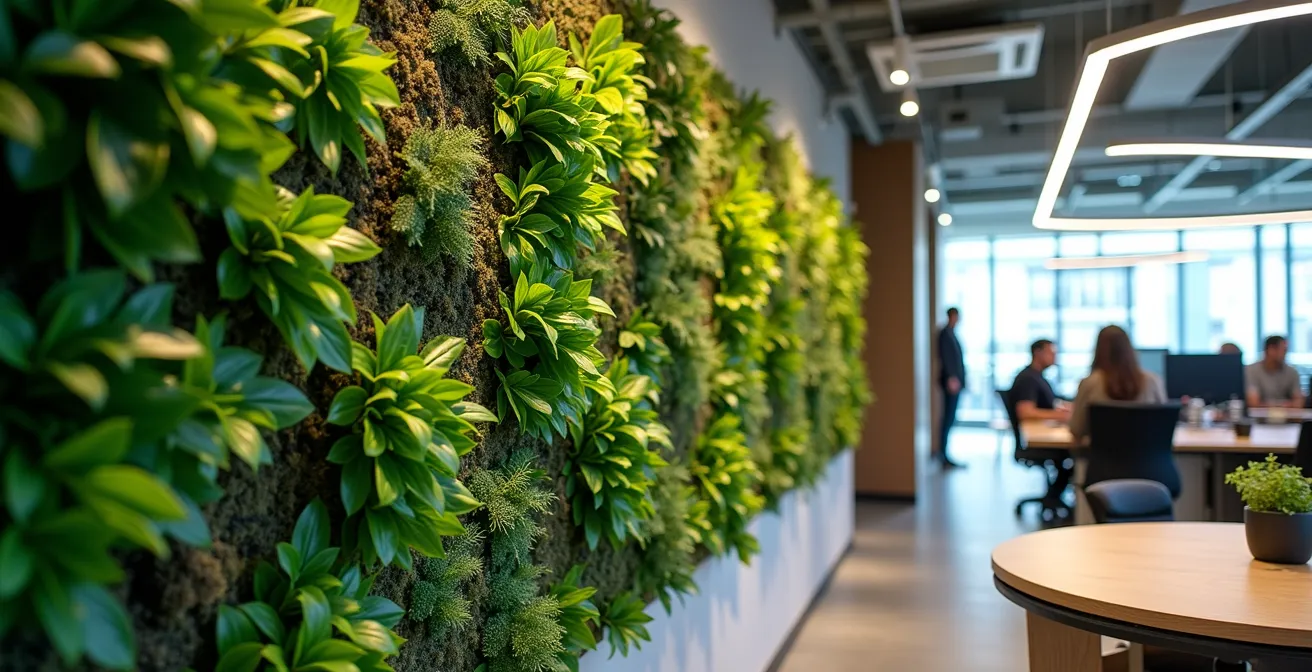
The goal is to create an immersive natural experience, not just decorate with greenery. This means thinking in terms of living walls, integrated planters, and using natural materials like wood and stone. These elements have been shown to lower blood pressure, reduce stress hormones, and increase feelings of well-being, which are all precursors to better cognitive function. The key is to design a system, not just place objects. This involves choosing low-maintenance species (like Snake Plants or ZZ Plants) and, for larger installations, partnering with a professional plantscaping service that handles watering, feeding, and replacement. This turns the “maintenance nightmare” into a managed, predictable operational expense with a clear wellness ROI.
This shift in mindset—from decoration to strategic environmental investment—is being adopted by leading corporations. For example, Amazon’s significant investment in a state-of-the-art HVAC system for its Arlington office was driven by a new understanding of air quality as a business imperative. While not a plant-based solution, it demonstrates the executive-level commitment to engineering a high-performance environment. A well-executed bio-integration strategy operates on the same principle: it’s a deliberate calibration of the workspace to support the human asset, not just an aesthetic afterthought.
Natural Light vs. Circadian LED: Is the Investment Worth It for Night Shifts?
For decades, office lighting has been treated as a simple utility: make it bright enough to see. This ignores the profound biological impact of light on human performance. Our bodies are hardwired to respond to the changing color temperature and intensity of natural daylight, a cycle that governs our sleep, alertness, and hormone regulation—our circadian rhythm. Standard office fluorescents provide a static, biologically “dumb” light that disrupts this rhythm, contributing to eye strain, fatigue, and reduced concentration, especially for teams working outside traditional 9-to-5 hours.
This environmental stress is not trivial. While data on lighting is complex, related research on thermal stress provides a powerful analogue. Studies show a measurable 1% cognitive ability loss per degree Celsius increase in ambient temperature above the optimal range. Just as thermal stress creates cognitive drag, so does “light stress.” For night shifts or teams in deep-plan offices with no access to windows, this is a chronic performance inhibitor. They are operating in a state of permanent jet lag, induced by the building itself.
This is where circadian-rhythm LED lighting becomes a strategic investment, not a luxury. These systems automatically adjust their color temperature and intensity throughout the day to mimic the natural progression of sunlight. In the morning, they emit a cool, blue-toned light that promotes alertness. As the day progresses, the light shifts to a warmer, yellower tone, signaling to the body to wind down. For night shifts, the cycle can be programmed to provide an “artificial daylight” that supports peak alertness during their working hours and helps regulate their sleep cycles when they go home. The investment is significant, but the ROI comes from improved alertness, fewer errors, and better employee health and retention in roles that are notoriously difficult to staff.
The HVAC Mistake That Causes Chronic Headaches and Absenteeism
The Heating, Ventilation, and Air Conditioning (HVAC) system is the mechanical heart and lungs of your building. Its primary job is not just to control temperature, but to circulate and filter the air your team breathes. The most common and damaging mistake companies make is treating this system as a fixed asset that only needs attention when it breaks. Specifically, neglecting filter quality and replacement schedules allows a slow, invisible poison to accumulate in your office: PM2.5. These are fine particulate matter smaller than 2.5 micrometers, capable of bypassing the body’s natural defenses and entering the bloodstream, causing inflammation and oxidative stress.

The sources are everywhere: vehicle exhaust from outside, dust, and off-gassing from office furniture and carpets. When your HVAC filters are cheap or clogged (below a MERV 13 rating), they fail to capture these particles, instead recirculating them endlessly. The result is a workforce suffering from chronic low-grade inflammation, manifesting as persistent headaches, fatigue, and respiratory irritation. This is a direct driver of both absenteeism (sick days) and, more insidiously, presenteeism (employees who are at work but operating at a fraction of their capacity).
The cognitive cost is direct and has been precisely quantified. The Harvard Global CogFx study, which monitored office workers across six countries, found a direct correlation between PM2.5 levels and mental processing speed. The data showed that for every 10μg/m³ increase in PM2.5, there was a corresponding slowdown in response times. Specifically, the Harvard’s Global CogFx study found 0.8-0.9% slower response times on cognitive tests. This may seem small, but compounded across your entire workforce over a year, it represents a massive loss of productivity and agility, all because the wrong filter was chosen to save a few dollars.
How to Schedule Cleaning Shifts to Minimize Disruption and Maximize Hygiene
Your cleaning crew may be one of the most underestimated contributors to your team’s health and cognitive performance. A flawed cleaning protocol does more than just leave a few dust bunnies; it can actively introduce harmful chemicals into the air and fail to remove the biological threats that lead to outbreaks. The two most common errors are scheduling and material selection. Cleaning during work hours, while seemingly efficient, often means using high-VOC (Volatile Organic Compound) sprays that off-gas into the occupied space, contributing to headaches and that “chemical smell” that signals poor air quality. Conversely, a superficial after-hours clean may miss high-touch surfaces, creating a perfect transmission vector for viruses.
A truly effective strategy requires designing a hygienic cadence—a schedule and protocol built around health outcomes, not just appearance. This means scheduling deep cleaning and disinfecting tasks for off-hours to allow for proper ventilation and dissipation of any chemicals. During the day, the focus should shift to targeted, high-visibility cleaning of common areas and high-touch surfaces (door handles, coffee machines, elevator buttons) using low- or zero-VOC products. This minimizes both chemical exposure and viral transmission risk without disrupting workflow.
This strategic approach to cleanliness is a direct response to a fundamental design flaw in our approach to buildings. As a leading expert in the field, Joseph Allen from the Harvard T.H. Chan School of Public Health, has noted, our standards are simply too low. In a 60 Minutes interview on the topic, he stated:
We haven’t designed for health. We have bare minimum standards.
– Joseph Allen, 60 Minutes interview on healthy buildings
Moving beyond these bare minimums is not a cost center; it is a risk mitigation strategy. Every flu outbreak that sweeps through the office, causing a wave of absenteeism, is a failure of the building’s hygiene protocol. By investing in a smarter hygienic cadence, you are directly investing in uptime and operational continuity.
How to Structure Your Morning Routine to Peak for 10 AM Board Meetings
An executive’s morning routine is often meticulously planned: exercise, a healthy breakfast, a review of key priorities. They arrive at the office primed for peak performance, ready for that critical 10 AM board meeting. And then they walk into the building, and that peak state begins to immediately degrade. Why? Because the office that sat empty all night is an unventilated box filled with stale, CO2-heavy air off-gassed from carpets, furniture, and paint.
This morning “CO2 bomb” is a critical, overlooked performance killer. While the executive was optimizing their body and mind, the building was passively sabotaging their efforts. Within minutes of sitting down at their desk, the elevated CO2 levels begin to impact cognitive function. This is not a theoretical risk. Rigorous scientific research demonstrates a clear dose-response relationship between carbon dioxide and cognitive throughput. The data shows that for every 500ppm increase in CO2 concentration, there is a 2.1-2.4% lower cognitive throughput. By the time the 10 AM meeting starts, their cognitive edge has already been blunted by the air they’ve been breathing.
The pandemic-era shift to remote work provided an unintentional case study on this phenomenon. A study of remote workers found that their cognitive performance was highly sensitive to their home office environment, with those who actively managed factors like temperature and ventilation showing significantly better results on complex tasks. They had control. Upon returning to a centrally managed office with a flawed environmental strategy, that control is lost. The solution is operational: the building’s HVAC system should be programmed for a “morning flush” cycle, running on high ventilation for at least an hour before the first employees arrive. This purges the accumulated stale air and ensures that the environment is calibrated for performance from the moment your team walks in the door, protecting the investment they’ve made in their own readiness.
The Cleanliness Protocol That Prevents Flu Outbreaks in Shared Desk Environments
The rise of hot-desking and shared workspaces has created undeniable benefits in flexibility and collaboration. It has also created a perfect storm for the rapid transmission of infectious diseases like influenza and norovirus. Each shared keyboard, mouse, and desk surface becomes a potential transmission point. A single sick employee can inadvertently contaminate multiple workstations, creating vectors that can lead to a full-blown office outbreak, crippling productivity for weeks. A simple “wipe down” policy is insufficient because it relies on inconsistent human behavior and often fails to address the biggest threat: airborne transmission.
A robust cleanliness protocol for shared environments must be multi-layered, addressing both surface and airborne threats. The foundation of this is superior ventilation. Pathogens are expelled in aerosols that can linger in stagnant air for hours. Increasing the rate of air changes per hour (ACH) dilutes these contaminated aerosols, drastically reducing transmission risk. An Italian study conducted during the pandemic provided a stunning validation of this principle, showing an 80% reduction in COVID-19 infections with 5 air changes per hour in schools. While the pathogen is different, the physics of aerosol dilution is the same, making high ACH a critical defense against flu outbreaks.
Beyond ventilation, a systematic protocol is needed to manage the physical space. This involves both technology and process. Upgrading HVAC filters to MERV 13 or higher is non-negotiable for capturing airborne viral particles. Providing individual “Clean Desk Kits” with low-VOC sanitizers empowers employees to take ownership of their immediate space. But to truly build a resilient system, you need a clear, enforceable plan.
Action Plan: Shared Desk Hygiene Protocol
- Humidity Control: Maintain indoor humidity levels between 40-60%. This range is proven to be the least hospitable for viral survival and transmission.
- Filtration Upgrade: Mandate the use of MERV 13 or higher filters in all HVAC units to effectively capture airborne viral particles.
- Empower Users: Provide each employee with a personal “Clean Desk Kit” containing low-VOC sanitizing wipes and hand sanitizer.
- Go Touch-Free: Where feasible, implement touch-free systems for entry doors, restrooms, and pantries to reduce high-frequency contact points.
- Monitor the Air: Install real-time CO2 monitors in all shared zones. A rising CO2 level is a direct indicator of insufficient ventilation.
Key Takeaways
- Your office environment is not passive; it’s an active factor directly impacting your team’s cognitive performance and bottom line.
- Invisible elements like CO2 and PM2.5 are not trivial annoyances but potent cognitive pollutants that cause measurable drops in productivity.
- Investing in environmental calibration (better ventilation, lighting, hygiene) is not a cost but an ROI-driven strategy to reduce absenteeism, improve decision-making, and boost employee retention.
Designing an Office That Candidates Photograph and Share on Instagram?
In a competitive talent market, your office is no longer just a place to work; it’s a critical piece of your employer brand. Top candidates don’t just look at salary and benefits; they evaluate the environment where they will spend a third of their day. An office that is visibly and demonstrably healthy is a powerful recruitment and retention tool. It sends a clear signal that you invest in your people’s well-being. This is where strategic environmental design becomes a marketing asset.
Features that are visually striking and directly linked to wellness—like a lush living wall, sleek digital displays showing real-time air quality data, or serene wellness rooms—become “Instagrammable moments.” When a candidate tours your office and sees these features, it creates a powerful, positive impression that often gets shared on professional networks like LinkedIn or social media. This organic marketing is far more authentic and impactful than a standard careers page. Leading companies are now formalizing this strategy by pursuing building certifications like WELL or Fitwel. These rigorous, third-party standards validate that your building meets high criteria for health and well-being. Displaying these certification plaques in your lobby is like displaying a quality seal, turning your real estate into a tangible employee benefit.
Of course, these features represent a significant investment. As a leader, you need to weigh the visual impact against the tangible health benefit and cost. The decision is not about aesthetics alone but about a calculated choice to build a space that is both a high-performance engine and a powerful magnet for talent.
| Feature | Visual Impact | Health Benefit | Cost Range |
|---|---|---|---|
| Living Wall (100 sq ft) | Very High | Biophilic stress reduction | $15,000-$25,000 |
| Digital Air Quality Display | High | Transparency & awareness | $3,000-$5,000 |
| Natural Material Finishes | High | VOC reduction | $10,000-$30,000 |
| Wellness Room/Pods | Medium | Mental health support | $20,000-$40,000 |
| Certification Plaques | Medium | Validated standards | $30,000-$100,000 |
The first step to calibrating your performance engine is to stop guessing and start measuring. Commission a professional audit of your office’s indoor air quality, including CO2, PM2.5, VOC levels, and ventilation rates. Treat this data not as a facilities report, but as a critical business intelligence document that reveals the hidden brakes on your team’s potential. Your role as a leader is to engineer the conditions for success, and in the 21st century, that engineering starts with the air your team breathes.